Online auctions are one of the few business models where the website earns money every time other people trade. You don't need stock, a warehouse or a team of buyers: your sellers bring the items, your bidders bring the competition, and your website takes a small fee on every sale.
This guide walks you through the whole process, from the first idea to a live auction website that earns commissions.
1. Choose a Niche You Can Own
The biggest marketplaces already exist. Your opportunity is a niche where buyers want expert knowledge and better filters: classic cars, watches, sneakers, vinyl records, art, coins, farm machinery, surplus stock, charity auctions or a local region.
A good niche has three things:
- Items that are unique or rare, so an auction makes sense
- Passionate buyers who search for specific brands, models or years
- Sellers who are not happy with the fees or the audience of the big platforms
Start narrow. It is much easier to become the best auction site for vintage watches than another general marketplace.
2. Decide How You Will Make Money
Auction websites usually combine several fees:
- Seller commission – a percentage of the final price, for example 5–10 %
- Buyer's premium – a percentage added to the hammer price, common at auction houses
- Listing fee – a small fixed fee per item
- Featured upgrade – sellers pay to appear on the home page
- Advertising – banners from related businesses
Our guide on how to make money with an auction website explains which combination works best for each type of marketplace.
3. Choose Your Auction Software
You have three options:
- Hosted auction platforms – quick to start, but you pay every month, often a percentage of every sale, and you never own the software.
- WordPress auction plugins – cheap at first, but they depend on themes and other plugins and become slow and fragile as you grow.
- A self-hosted auction script – you pay once, install it on your own server, own the source code and keep all your revenue.
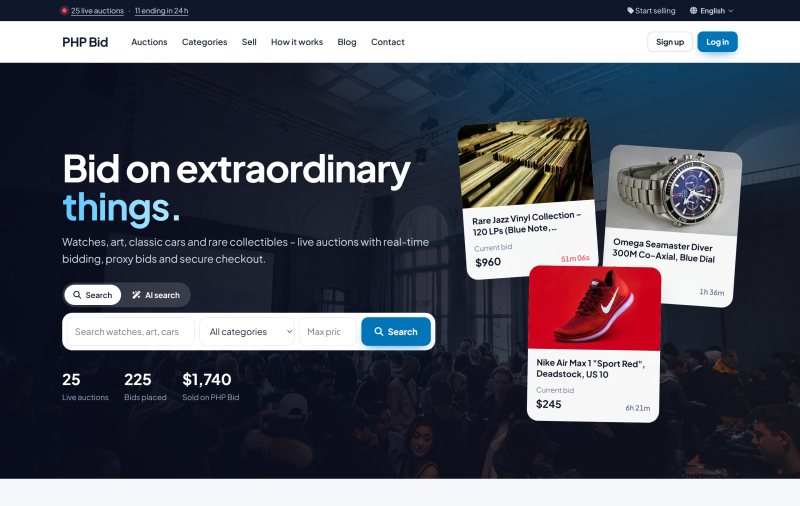
For a serious business, a self-hosted auction script is usually the best long-term choice. PHP Bid includes everything a modern auction website needs out of the box: automatic bidding, Buy Now, Make an Offer, Stripe and PayPal payments, commissions and buyer's premium, an AI listing assistant, AI search and eight professional designs.
4. Set Up the Rules of Your Marketplace
Before you launch, decide:
- Who can sell: every member, approved members only, or only you
- Whether new listings need approval
- The auction durations you offer (for example 3, 5, 7 or 10 days)
- Your anti-sniping rule: how much an auction is extended when a late bid arrives
- Your bid increments: how much each new bid must be higher
- VAT and shipping options if you sell to businesses or across countries
5. Get Your First Sellers
An empty marketplace attracts nobody. Before launch, list a first batch of items yourself or with a few partner sellers. Offer your first sellers free listings or a reduced commission, and make listing easy: an AI listing assistant that writes the title and description and suggests the prices removes the biggest barrier for new sellers.
6. Bring in Bidders
- Publish buying guides in your blog for the searches your buyers make
- Share your best lots on social media and in niche forums
- Collect newsletter subscribers and send the best lots every week
- Use saved searches so buyers get an e-mail when a matching item is listed
7. Launch, Measure and Improve
Watch which categories get the most bids, which sellers bring the best items and where visitors leave. Add category fields and filters for your most popular categories, feature your best lots, and keep adding content.
Ready to Try It?
The fastest way to understand what your auction website could look like is to click around in a real one. Try the PHP Bid live demo: place bids, make an offer, list an item with the AI assistant and explore the admin panel.